
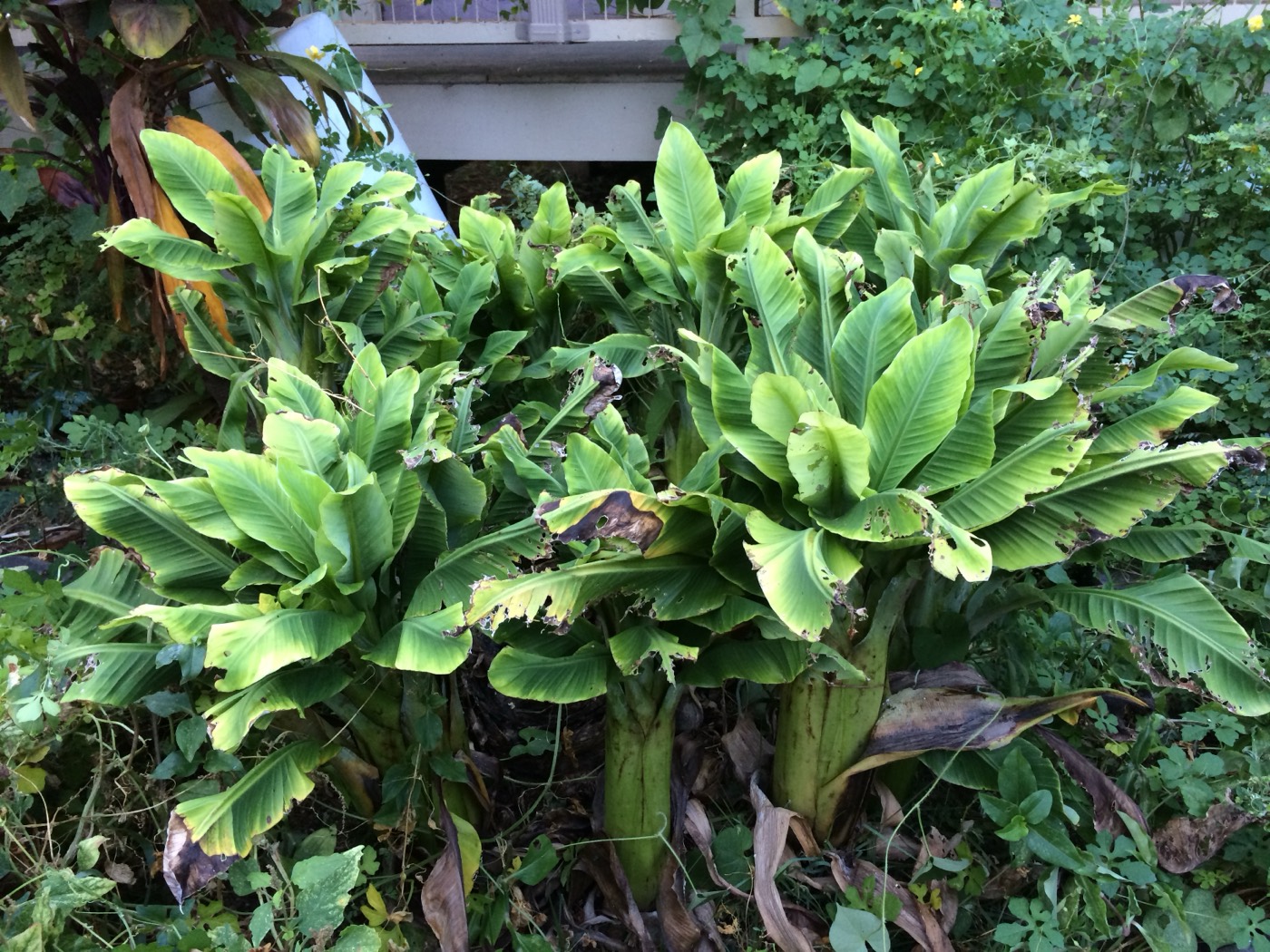
If your backyard bananas have started coming up short, stiff, and bunched at the top — with new leaves that are narrow, wavy, and yellow around the edges — you may be looking at Banana Bunchy Top Virus (BBTV). It’s the single most serious disease of bananas in Hawaii, it has no cure, and it’s been established on Oahu since 1989. If you grow bananas here, this is the one to know cold.
This isn’t scare-copy. BBTV is a Hawaii-specific problem with real quarantine rules, a destroy-the-infected-plant protocol, and a reporting channel that actually matters. What you do in your own yard — and what you don’t move to your cousin’s place in Kona — genuinely affects whether it keeps spreading. Here’s the whole picture.
What BBTV actually is
Banana Bunchy Top Virus is a plant virus — not a fungus, not a bug you can squash. According to UH-CTAHR’s Plant Disease publication PD-12, it’s “one of the most serious diseases of banana,” and once it’s established it’s “extremely difficult to eradicate or manage.” No banana variety is resistant — the popular Cavendish types actually catch it more easily than most. Infected plants rarely fruit at all, and when they do, the hands come out small, twisted, and deformed.
The key thing to understand: the virus lives inside the plant and its connected root mass. You can’t wash it off, spray it away, or nurse the plant back. Once a banana has BBTV, it’s done — and it becomes a reservoir that infects everything around it.
How to spot it on your Oahu property
Learn to read the leaf. The early signs are subtle and the late signs are obvious — catch it early and you save yourself a bigger mess. In roughly the order they show up:
- “Morse code” streaking. Dark green streaks — a series of dots and dashes — along the lower leaf stem (petiole) and midrib. Rub away the waxy white coating on the stem to see them clearly. This is the most reliable early tell.
- “J-hook” marks. Short, dark green hook-shaped extensions of the leaf veins in the pale zone next to the midrib, pointing down toward the base of the leaf. Back-light the leaf against the sky and they pop out. CTAHR has a close-up of the hooking symptom.
- Bunched, stunted new growth. New leaves emerge narrow, wavy, stiff, and erect, with yellow (chlorotic) margins, crowded at the top of the plant. This is the “bunchy top” the disease is named for.
- Deformed or absent fruit. Severely infected plants usually don’t fruit; if they do, the fruit is twisted and stunted.
Keiki (suckers) that come up from an already-infected mother plant are usually the most obviously stunted of all — short, stiff, bunched, and they’ll never fruit.
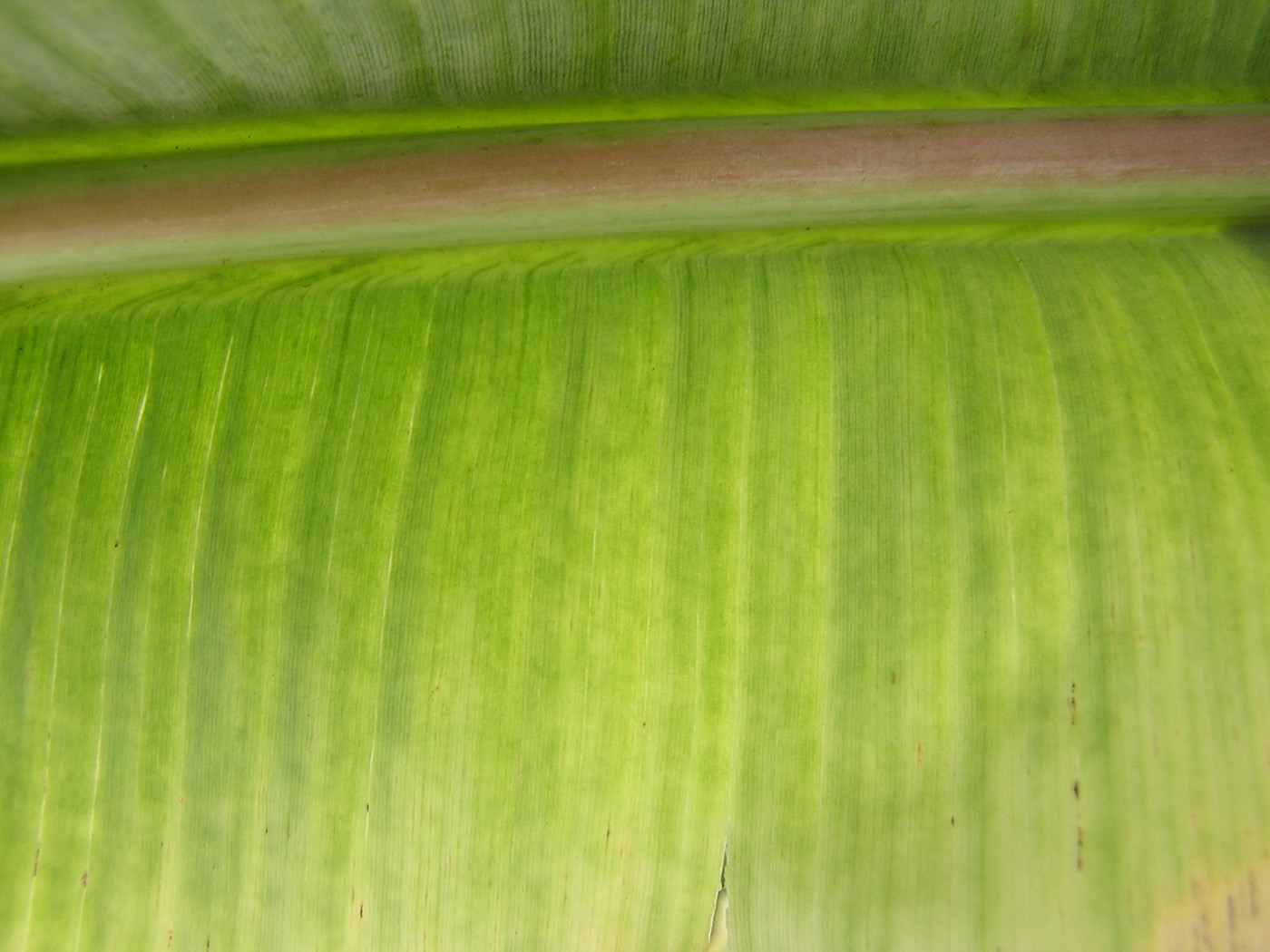
Watch for look-alikes. The Hawaii Early Detection Network notes that cucumber mosaic virus (also spread by the banana aphid) and simple nutrient deficiencies — like calcium or boron — can cause yellowing and deformed growth that gets mistaken for BBTV. The Morse-code streaking on the leaf stem is your best differentiator. When you can’t tell, report it and let the experts confirm.
The aphid is how it moves
BBTV doesn’t travel on its own. It’s spread by the banana aphid (Pentalonia nigronervosa) — small brown-to-black insects that hide in the leaf pockets, on young suckers, and down inside the whorl of the newest unfurled leaf. Per CTAHR, an aphid picks up the virus after feeding on an infected plant for as little as a few hours (usually about 18), carries it for a couple of weeks, and can pass it to a healthy plant in as little as 15 minutes of feeding. Symptoms then take about a month to show up — so by the time you see it, the aphids have often already moved on.
Two important wrinkles for an Oahu yard:
- The aphids also live on heliconia and flowering ginger. Those plants don’t host the virus itself, but they host the aphid — so if you’ve got banana plus ginger or heliconia nearby, treating all of them for aphids helps knock the population down.
- People are the other vector. The virus jumps islands and neighborhoods when someone moves an infected sucker or corm. Every Hawaiian island got BBTV from Oahu-origin plant material. Which brings us to the law.
Why moving banana plants is a quarantine issue
This is the part that’s genuinely regulated, and the part homeowners most often don’t know. Per CTAHR PD-12:
- Hawaii law prohibits importing banana planting material into the state without a permit and a one-year quarantine period.
- The Hawaii Department of Agriculture has imposed a local quarantine prohibiting movement of banana plants and plant parts — except fruit — off Oahu (and the Kona area of Hawaii Island) to other islands.
Practically, that means: don’t ship or carry banana keiki, corms, suckers, or leaves to another island. Fruit is fine. Planting material is not. And even where it’s not strictly prohibited, moving banana suckers between islands is officially not recommended, because that’s precisely the pathway that spread BBTV statewide.
One honest caveat on what the law does and doesn’t do: the state’s older Big Island quarantine (imposed in 1999) couldn’t contain the disease and was eventually disbanded in favor of an elimination strategy, and as the Honolulu Star-Advertiser reported, officials “can’t force people to kill their plants without a court order.” So the destroy-the- infected-mat protocol below is strongly recommended best practice — and the neighborly thing to do — rather than something the state will show up and cite you for on private property. The movement quarantine, though, is a real rule. Don’t move the plants.
How to deal with an infected plant (the right order matters)
There is no cure, so the goal is: kill the aphids first, then destroy the whole mat. Order matters — if you hack down an infected plant while the aphids are still on it, you just launch a cloud of virus-carrying aphids onto your healthy bananas. BIISC and CTAHR both spell this out:
- Treat for aphids first. Homeowners can use insecticidal soap or a soapy-water spray — relatively non-toxic and effective if you soak the hiding spots: the leaf petioles, the pockets where petioles meet the stem, young suckers, and inside the newest unfurled leaf. Then leave the plant alone until the next day. It may take a second treatment.
- Remove the fruit if there’s any worth keeping (fruit is safe to eat and safe to keep).
- Destroy the entire mat — not just the sick-looking plant. Even if only one sucker looks infected, the whole connected mat is almost certainly infected. Dig up the main corm and every keiki so it can’t regrow. Chemical option per CTAHR is a glyphosate product labeled for banana, injected into the pseudostem; mechanical option is cutting the whole clump down and pulling every sucker.
- Dispose so it can’t regrow. CTAHR lists incineration, landfill burial, thorough chopping and drying, or sealing in black plastic bags to rot. BIISC’s guidance for cut material is to let it decompose in place rather than hauling it around — moving it is how the virus travels.
- Go back and check. Regrowth means repeating aphid control and removal until the mat is completely dead.
On pesticides and labels: if you go the chemical route, follow the product label and HDOA rules exactly. Some banana uses in Hawaii require a Special Local Need label you’re supposed to have in hand at the time of application — check with the retailer or HDOA Pesticides Branch. Read the label, follow it, don’t freelance.
DIY vs. call a pro — the honest call
Do it yourself: identifying the streaking and hooks, spraying aphids with insecticidal soap, digging out a small infected mat, disposing of it correctly, and — most importantly — reporting it and not moving plant material. None of that needs a contractor, and if you’ve got kupuna in the family with a beloved backyard patch, this is exactly the kind of thing you can teach and handle together. That’s the whole point.
Hire a pro when the infected mat is large, tangled, or mixed into other landscaping you don’t want to damage, when there’s a big volume of green material to remove and dispose of correctly, or when you’d rather someone else handle the herbicide and disposal properly. See tree service for clearing and haul-out — just make sure whoever does it understands they can’t truck banana material off-island.
How to report it (do this even if you already killed the plant)
BBTV is on Hawaii’s early-detection pest list, and reporting helps the state map how far it’s spread. Report through the 643PEST network, which routes to the Hawaii Department of Agriculture (Honolulu Civil Beat covered how it works):
- Report online at 643pest.org, or
- Call 643-PEST (808-643-7378)
Snap a clear photo of the streaking or bunched leaves if you can. Reporting takes a couple of minutes, it’s free, and — together with keeping your banana plants where they are and destroying the infected ones — it’s one of the genuinely useful things you can do to keep Oahu’s backyard banana patches alive.
Sources
- UH-CTAHR, Banana Bunchy Top Virus (Plant Disease PD-12): https://www.ctahr.hawaii.edu/oc/freepubs/pdf/PD-12.pdf
- UH-CTAHR, Bunchy Top Disease of Bananas (Commodity Fact Sheet BAN-4A): https://www.ctahr.hawaii.edu/oc/freepubs/pdf/CFS-BAN-4A.pdf
- UH-CTAHR BBTV resource hub (symptoms, hooks, banana aphid): https://www.ctahr.hawaii.edu/bbtd/
- Big Island Invasive Species Committee (BIISC), Banana Bunchy Top Virus: https://www.biisc.org/pest/banana-bunchy-top-virus/
- Hawaii Early Detection Network / Report a Pest, Banana Bunchy Top Virus: http://www.reportapest.org/pestlist/bbtv.htm
- 643PEST — Hawaii Department of Agriculture pest reporting: https://643pest.org/
- Honolulu Civil Beat, Hawaiʻi Residents Are Keeping A Keen Eye On Invasive Species (2026): https://www.civilbeat.org/2026/01/hawai%CA%BBi-residents-are-keeping-a-keen-eye-on-invasive-species/
- Honolulu Star-Advertiser, Banana disease continues to spread on Big Island (2015): https://www.staradvertiser.com/2015/12/28/breaking-news/banana-disease-continues-to-spread-on-big-island/
FAQs
My banana leaves look bunched and yellow at the top — is it definitely BBTV?
Maybe, but not always. The most reliable early sign is dark green "Morse code" dot-and-dash streaking on the leaf stem and midrib, plus little dark green "J-hook" marks along the midrib (back-light the leaf against the sky to see them). Bunched, narrow, stiff, yellow-margined new leaves are the later stage the disease is named for. Nutrient deficiencies and cucumber mosaic virus can look similar, so if you're not sure, snap a photo and report it — UH-CTAHR extension can help confirm it.
Can I move banana keiki or give a sucker to a friend on another island?
No — and this is the part that's actually regulated. Hawaii law requires a permit and a one-year quarantine to bring banana planting material into the state, and the Hawaii Department of Agriculture has a local quarantine prohibiting movement of banana plants and plant parts (fruit is fine) off Oahu to other islands. Moving infected suckers is exactly how BBTV spread across every island in the first place. When in doubt, don't move the plant — just the fruit.
Do I really have to destroy the whole clump if only one plant looks sick?
Yes. Because the virus lives in the connected root mass (the mat), by the time one sucker shows symptoms the whole mat is usually already infected. CTAHR's guidance is to kill the aphids first, then remove and destroy the entire mat — corm and all keiki — even if only a single sucker looks infected. A symptomatic plant that's left standing is a reservoir that keeps re-infecting the neighborhood.
Is there any spray that cures an infected banana plant?
No. There is no cure for BBTV. Insecticide or insecticidal soap kills the aphids that spread it, which protects your healthy plants, but nothing saves a plant that's already infected. Once it's got the virus, the only move is to destroy it.